Saturday, April 20, 2019

Tribute to Sam Moore - April 11, 1931 ~ October 6, 2017

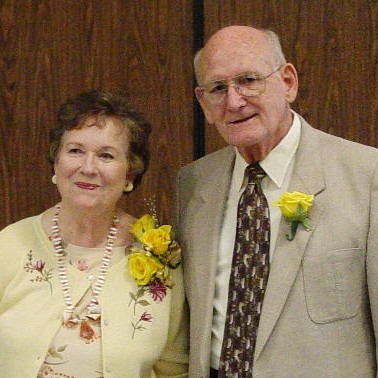
Samuel D. Moore, author of this blog, passed away peacefully at home in the ever present company of his wife of 63 years, 4 months and 2 days, as well as his oldest daughter, on October 6th, 2017.  

After various engineering positions over the years at GAC, Convair, Sam began a 29 year career at Texas Instruments. During his time at TI, he authored or co-authored 6 US Patents and several journal papers before retiring in 1989. He was pulled back into the engineering world to work with friends a few times, but preferred retirement.

Sam was diagnosed with Parkinson’s Disease around 2010. His engineering brain would not let him rest easy and he began to research treatments, even blogging about his findings, treatments, politics, etc., in his last few years. He wrote a program to profile medication effects and had hoped to carry on developing his program in conjunction with a Parkinson’s research organization or Pharmaceutical company, in order to benefit other patients. The combination of the Parkinson’s Disease progression and a fall in which he broke his shoulder, halted that effort. Special thanks to his neurologist, Dr. Peter Lin, for listening to his ideas, partnering with him in his care/treatment and encouraging his research and program development.

Sam was always a singer, with a strong, rich bass voice. Even in his last days, he could be heard singing “Old Man River”. He had a wonderful sense of humor, even while in the hospital. When a nurse came in to test his memory, asking “Do you know what hospital you are in? What city?”, he would answer with a twinkle in his eye, “Why? Are you lost?” He loved to invent, tinker and build things, including elaborate playhouses for his daughters, a significant play structure for his grandchildren and even a houseboat. He’s the one everyone went to for advice on all things electrical or mechanical, cars, woodworking, etc. He is fondly remembered by his nieces and nephews who had experienced his generosity of spirit and unconditional acceptance.

He is dearly missed for his engineering, curious mind, his practical advice and support, his sense of humor and love.

He is survived by his wife, 2 daughters, son-in-law, 2 grandchildren and many nieces and nephews.

Tuesday, February 7, 2017

   WHAT THE INSURANCE COMPANIES DON'T WANT YOU TO KNOW 
 ABOUT DENTAL INSURANCE
BY SAM MOORE


I have not been able to take care of my teeth like I should because of my Parkinson's disease.  As a result, I had to make a visit to a dentist.   Knowing that I needed work done on my teeth, I added dental insurance to my health plan with Alignment Ins.
When I had my appointment, I discovered I needed $40,000 of work done.  I ask the dentist what it would cost if  I didn't have insurance.  The answer was double or $80.000.  With a few additional questions, I found that the insurance cut the cost to me by  50%.  That on the surface seems like a terrible burden on the insurance company.  The question I had was, how does the insurance company stay in business?   I ask that question of the dentist.  The response was, don't worry  about the insurance company, they negotiate a rate with the dentist.   This smells bad, somebody is taking a beating.

Guess what,  it is the patient.     I don't know where the fraud lies, but I know somebody is profiting from the situation.   Pinning the blame is going to be difficult.  I have come up with two quiet different scenarios leading to the situation.

The first, lays the blame on the dentist.  I don't believe this is the case.  The second, places the blame, I believe, on the rightful place, the Insurance industry.   In the first scenario, the dentist's conspire to boost the price of their services by a factor of two.  They then clue the insurance companies into the idea of selling an insurance plan.   They convince the public that the insurance is paying for the  service, leaving a significant copay for the patient..  What is really happening is, the Insurance company negotiates a price for the services, individually, with each dentist.

In the second case, the most probable,  the insurance industry, either, cons, or pressures the dentists into increasing their prices.  The insurance company, then "negotiates" the prices of the services.  As a  result, the insurance co. can say they are insuring the patient when actually they are selling a discount card at no cost to themselves.   Check it out, you can get a discount card for free that allows you to get 50% off on your dental services.

I believe greed allows this fraud to continue,  It appears, the insurance industry is the profitee in the fraud.  The dentists go along with the situation because in the worst case they get a fair return for their services, and in the best case they get double the price from the unsuspecting  "uninsured". There are still some conscientious dentist, who have kept their prices at a reasonable level.  They don't get the insurance business because there is no room for price negotiation.

Saturday, February 4, 2017

       RYTARY THE KNEW "GOLD STANDARD" IN PARKINSON'S DISEASE TREATMENT
                                                                   BY SAM MOORE


A knew "Gold Standard" in PD treatment is now on the scene and is proving itself.  It is called Rytary, Ry-tar'-y..  I have just started using it so don't have any personal experience yet..  Without the price tag, it would quickly take over the  number one place in PD treatment.  The predecessor,  Sinemet  would  soon be history.
With my engineering background, I need an understandable, development history of any product I endorse.   Without the actual history,  I am compelled to invent my own.   Fortunately, I have a tool that gives  me under the skin insight into the interaction of medications with different absorption characteristics..   The tool is a medication profile plotter.   By entering the dosages and dose schedule of a day's medication protocol, I receive a plot of the days' medication blood concentration.  With this information,  I can reconstruct the thought processes and hard work that went into the development of Rytary.
Rytary is a progression of Extended Release, ER, and Control Release, CR,  Sinemet.  The advantage of ER/CR Sinemet is added therapeutic time.  A plot of the blood concentration, following doses of ER/CR Sinemet, is shown in figure one.


The advantages of this  configuration over IR Sinemet is obvious.  The disadvantage is the absorption time,  it takes too  long for the initial dose to take effect. I remember reading somewhere that Rytary uses a combination of IR and two versions of ER/CR. The developer of Rytary must have taken considerable time and research to come up with the combination of Sinemet versions  they settled on.   The  combination I arrived at in my analysis, 16.7% IR,  33.3% ER/CR 3 hour and 66.7% ER/CR 5 hour.
I have a friend who uses Rytary.  She takes two capsules  of 95 mg. Rytary 4 times a day.  This gives her 24 hour coverage of therapeutic medication.  This profile is shown in figure two.


Using the profile plotter, I would select  10 mgs. IR and 180 mgs. 5 hour.  The 24 hour plot is shown in  figure 3.  The addition of the 3 hour ER/CR does not appear to be of any real advantage.


.

For a trial use of the plotter contact Sam Moore at sdurwoodm@gmail.com.  Thirty day trial is free, Donations are accepted.  The plotter was developed to study Sinemet, and requires EXCEL, which is not included.


Friday, February 3, 2017

                                  FRONT PAGE FROM NEWSPAPER OF THE FUTURE

Wednesday, January 4, 2017

                     THE AMERICAN WORKER AND THE CAUSE OF THEIR PROBLEM


I have been seeking a revelation to explain the plight of the American worker. The answer is unexpected.  It is an old problem and surprisingly began with one of America's favorite sports,  high school  and human nature.   In the early days sportsman ship was taught from the beginning grades. You were taught to accept defeat and as a victor show respect to your defeated opponent.  As years went by, sportsmanship took a backseat to pride in being number one.  Soon winning was everything.  and second place was quickly forgotten.  This was the end of sportsmanship.

As you would expect, this attitude progressed as the younger  players advanced through the ranks, from high school, to college, to professional,  to national,  and so on, until the problem had permeated the entire sports world.  Today, nobody remembers the second place team or individual, twenty four hours after the winner is announced.   When I was named Salutatorian of my high school graduating class, I was treated like a celebrity, equal to the recognition given to the Valedictorian. Today, that achievement is hardly recognized.  

Being number one has become addictive.  No one is satisfied with anything less.  People will even resort to murder to achieve the number one position in any endeavor sports or otherwise.  As a result, we have dictators, Kings and other world leaders who resort to anything, legal or e legal to achieve the spot.  

Greed has become rampant.  The desire for recognition, fame, power, wealth, and all that it brings has ruined many a potential leader.  As a result, they become mean and vindictive and resort to any means to achieve their goals.  The real question is: what is the solution? As for me, "I don't have a clue".

So, let's start a dialog of finding answers.  I'm sure there is more than one answer and the solution may be one or a combination of answers.  Let's start by setting up a  dialog blog.  Who will volunteer to chair and set up the site.        

                                MORE EVIDENCE TO THE DELIMA OF THE WORKING CLASS
                                                              BY SAMUEL D. MOORE    

I watched the national college football game  on tv the other night.  I must say, it ranks at the top for excitement.  However, I noticed one incedent that strengthened my belief as to what happened to sportsmanship and ethics in the world.  The incedent probably  wasn't noticed by anyone else,  but that is the way my mind works.  It occurred  about midway through the contest.
One of the top receivers for Alabama, touchrd the incoming ball but failed to make the catch.   He immediately jumped up, making good catch signs with his arms, in an attempt to influence the official's call.  I believe most people today would ask, "What's wrong with that?".  Exactly, this is what's wrong.  The player knowingly tried to perpetuate a lie instead of accepting the truth that he failed to make the catch.  The desire to suceed overpowered his acceptance of the truth.
This attitude is epidemic in most of today's sports venuies.  The two notable exceptions are soccer and golf.   The result of this attitude is more rules and officials.  It has gotten so bad that it has interfered with the ability to complete a contest.  In football, it is almost impossible to complete a first down.  In basketball, it is almost impossible to make a shot from the field, resulting in the outcome of the game dependent on free throws and official's decisions..  In addition,  the attempts at shifting the blame for fouls  by faking a reaction has gone viral, so to speak.  The acting should have its own Golden Globe awards show.   Remember when:  The official calls a foul and the guilty player immediately raises his hand?

 Those are the sports I am familiar with.  I am not familiar enough with other sports  to comment on them.
The resulting greed and desire for success, has made its way into the political system.  At this point, it is hard to determine if the chicken or the egg was first.  This seems to be a worldwide phenomena.                                    
                         THE UNEMPLOYED OF THE  AMERICAN WORKFORCE EXPOSED
                                                                BY SAMUEL D. MOORE


I have tried to keep this blog out of politics.  I have abandoned that cause due to a posting of Dr. Phil's on Facebook.

WAKE UP AMERICA!!!!!!!

I have respected Dr. Phil until today.  I saw his comments about unemployment on the Facebook and it sent me into a rage.  His true colors are revealed.  Another major disappointment in my faith. Dr. Phil, do you really think the un- and under- employed enjoy their condition.  Face it: The greed of the overpaid CEO's of this country, who, in the interest of there power and pocketbooks, have sent their jobs overseas, in the guise of high wages.  Now to bring them back,  they must accept minimum wages. They are even asking the American workforce to accept lower minimum wages, as a cost of bringing the jobs back, while management takes a bigger share of the profit. This is what we can expect of the administration's support of the American worker?  I am 85 years old, and, if I was physically, able would still be in the workforce, employing my fellow Americans.  I am working today, toward that goal.

I do not understand the fact that the American workforce doesn't recognize this situation.  I guess the truth is, they have been told a lie so much, that they now recognize it as the truth.  All you have to do to recognize the truth of the situation is, look at the economy growth since the democrats took partial control of our government.  Think what could have been achieved if they had full control.  Instead the republicans have thrown up roadblocks to any attempt at helping the citizens of this country, in an attempt to make Obama a failure, purely for bigot reason,s.  " TO HELL WITH THE CONSTITUTION, DESTROY OBAMA".  

I realize that this will anger many people, but, I no longer care. What I am saying needs to be said. If it enlightens just one person it is worth it.  

I hope to return to my original subject in my next posting.


Tuesday, January 3, 2017

                         DYSKINESIA DOSE SUSCEPTIBILITY RANGE
                                                         BY Sam Moore

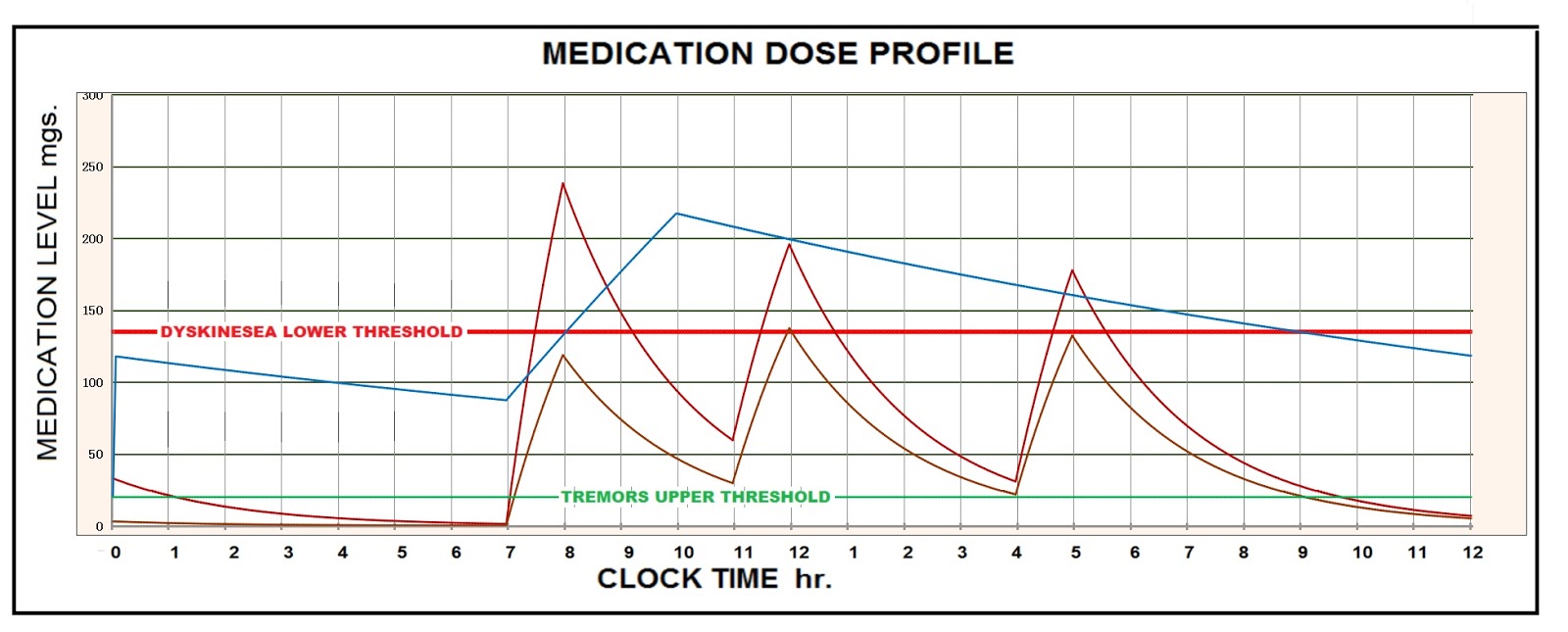
I have found that my dyskinesia has a susceptibility range.  The range starts at about 100 mgs of levodopa IR and continues at levels of levodopa higher than I have experienced.  The Figure below shows the range I have experienced.   The intensity of the dyskinesea, when it occurs is proportional to the highest level just before the elimination period starts.  At levels less than the susceptible range is a safe range. This range starts at a level where the tremors cease.


The information is patient sensitive and will not be the same for everyone.  Relating the information to blood concentration, one hundred mgs. is equivalent to approximately 18.2 mg/ml blood concentration.  For my body weight, about 5.5 liters of blood.

The blue/green line is for 150 milligrams taken three times a day.  While I was on that protocol I did not suffer with tremors or dyscinesea.  I attribute that to the level being most of the time above the upper limit of tremors. I believe this dose level is too low to be therapeutically beneficial.

The red line is for 200 mg. taken 4 times a day. This was the worst I have suffered with dykinesea, both in length and intensity.   I never want to go through that again.  The higher the peak just before the dyskinesea, the higher the intensity.

I have been looking at profiles of  Rytary.  I think I have it down pretty good.  I understand that a friend of mine is taking Rytary, Two 95 mg. tablets, 4 times a day.  I worked up a model of Rytary so I could plot a graph of the daily profile.  The result is the graph, shown below.
.
From my experience, I have found that you can have a condition where you get enough levodopa to eliminate the tremors, without having enough to  be therapeutic.  If I am correct, in the protocol that my friend is on,  I believe she is at this point.  I have taken into account that she is a small woman and would not require as large a dose as a man my size.  I believe in order to have a therapeutic effect you must have enough levodopa to make you susceptible to dyskinesea.  Fortunately, with the Rytary protocol, the level of medication remains at a high enough level to prevent triggering of dyskinesea. In the plots,  I have shown the profile for the 190 mg. tablet.

I am attaching my dose profile for a comparison to the Rytary profile.  I use a protocol of sinemet, because it is cheap, that makes me take my doses every two hours.  It ends up putting me in a dyskinsea sensitive range much of my dose period.  That combined with the large fluctuations of medication level causes me to put up with dyskinesea several times every day.   It is not possible to have 24 hour coverage .  You are limited to 12 to 14 hours.   I miss doses on my schedule, because,  I sometimes am out of range of hearing of my timer, I forget to set or activate the alarm, or I accidentally turn the sound of my alarm too low to hear.


I am impressed by the Rytary profile, because you can get 24 hour coverage and it is less susceptible to Dyskinesea than my current protocol.   Except for the cost, I think Rytary is the best solution yet for a sinemet protocol.

I believe that for ease in comparing results between patients, it makes more sense to look at the profiles in terms of mg/ml, rather than in mgs.  Mgs/ml takes into account the weight of the patient with there associated blood volume.  In order to support this recommendation I have attached a graph with two profiles. One is of  two 95  mg. tablets of Rytary taken 4 times a day by a 155 lb. patient.  he other graph is of two 95 mg. tablets of Rytary taken 4 times a day by a 110 lb. patient.

As can be seen in the graphs,  the dose has a much stronger effect on the smaller patient.   This technique will narrow the gap for comparing results.
I believe that for ease in comparing results between patients, it makes more sense to look at the profiles in terms of mg/ml, rather than in ml.  This takes into account the weight of the patient with the associated blood volume.  In order to support this recommendation I have attached a graph with two profiles. One is of  two 95  mg. tablets of Rytary taken 4 times a day by a 155 lb. patient.  The other graph is of two 95 mg. tablets of Rytary taken 4 times a day by a 110 lb. patient.


As can be seen in the graphs,  the dose has a much stronger effect on the smaller patient.   This technique will narrow the gap for comparing results.

I hope you have found this article beneficial.  If so, please "Like" it on Facebook,  or comment on my blog.  Support PD research on the Michael J. Fox foundation.  Support this blog  with donations to my account  s_durwood_m@msn.com on Paypal, or contact sdurwoodm@gmail.com to send comments.  Both positive and negative comments are welcome, although positive ones are preferred. I will try to respond.                                                    


Friday, December 23, 2016

                              HOW DO YOU EVICT SQUATTERS?

This is a story about troubles with the Parkinson’s clan.  

I have a problem with squatters that have moved in and wont go away.  It started out innocently enough.  It would be a situation that was unpleasant but tolerable.  It began about six years ago when the patriarch of the family moved in.  The family name is Parkinson.

Soon other members of the family showed up.  There were Tremor,  Stiffness, Lethargy,  Insomnia and several others that moved in and out.

It soon became intolerable.   I started looking for someone to help me get rid of the unwanted visitors.  I selected a specialist with important letters before and after her name, only to be informed that she had no solution for my problem.  I then found another specialist, again with impressive credentials.  He started out trying several approaches.  Some of the approaches did no more than temporally move some of the family out but they always returned.  He tried one approach that involved the marriage of the patriarch to Levo.  At this point, the marriage produced an unplanned son that was named Dyskinesea.  Dyskinesea was too much for the specialist so he recommended another specialist that had narrowed his specialty to the Parkinson’s family.

The new specialist was sold on the marriage of the patriarch to Levo.  He tried marriage counselling to increase the bond between the two.  This worked to some extent; however, the relationship had lots of ups and downs.  Part of the problem with the marriage was Levo's  chronic gastric problem.  The solution to the problem was getting Carbi involved.   Carbi and Levo were twins of the Dopa family,  and had been separated by the marriage.

At this point in time the relationships were complicated by an across the country move.  I moved to live with my daughter and her family.  She fixed up a nice apartment for my wife and me in her home.   

A perfect opportunity to get away from the Parkinson’s clan.  Think again, they found a sucker and they intend to milk it dry.  So now I have to start again.  First find a new specialist.  My fourth specialist was there in name only.  I think he had retired early and forgot to tell anyone.  

So the patriarch followed with his clan and his wife, Levo,  and moved in on us again.

I was getting desperate at this stage, so I decided to foster a romance between Dyskinesea and a new entry, Mary Jane.   Mary Jane became an option because she was living in the state of California,  where we had moved.   This was a failure, so I continued my search for a new specialist.  Enter number five.

Like number four, number five had also entered premature retirement..  At this stage I gave up and decided I would have to go proactive.  I started by going to the internet and researching the various aspects of the Parkinson’s clan.  

I discovered that the Dopa family was extremely sensitive to the timing of their involvement.  I used a timer to time my attempts at involving Levo in the relationship. An immediate improvement resulted.  Then I found that a greater improvement occurred when I adjusted the intensity of my attempts.  By adjusting the intensity of the attempts along with the timing of the attempts, I could get an amplification of the effect.

Something was still missing.  I had no way of correlating the intensity and timing with the timing of the response from Levo.  Then I found that others had measured the push back response of Levo.  I could then predict the action of Levo by plotting the intensity of the attempt against timing of the attempts.  At first I manually plotted the chart using “Paint” and the laws of geometry.  This was slow and tedious, but it was an improvement in performance.  I then went to the computer and developed a spreadsheet algorythm to have the computer generate and plot the data for me.

I tried to interest my fifth specialist in my discovery, but he didn’t want to be bothered with any new ideas.  I found a sixth specialist.  Number six was a jackpot.  He was interested in my approach and encouraged me to continue developing the algorythm.

Number six decided that arbitration was in order, so he brought in two negotiators to try to bring some peace to the family.  He decided on Amanta and Rogeta, two intercessors who were able to smooth over some of the rough spots in the inter-family relationships.  Getting the arbitration process going had its own rough spots due to the high cost of the Rogeta half of the team.  Negotiating the contract price was difficult in itself.

That brings the story up to date.  I still have the clan on my back, but it is more predictable.  My next effort is to help others who have the same problem as I have.

If any reader of this story has any ideas about this subject, please contact Sam at sdurwoodm@gmail.com.       


                HOW DO YOU EVICT SQUATTERS?” EXPLAINED

The short story  “HOW DO YOU EVICT SQUATTERS?” was written to put some humor into the other wise hum drum life of PD patients.  For most patients the story would make sense; however, for the person unfamilier with the levodopa treatment of PD, some of the situations of the story might not be clear.  I will attempt to give some baqckground on the most prevalent treatment of the disease.

First PD is a progressive disease.  As of this date, it is incurable.  The best that can be done is minimize the symptoms of the disease.  It is believed that either a deficiency of Dopamine or a defect in the ability of the brain to utilize the Dopamine for firing the syenapsis.  The inability of the brain to utilize Dopamine, causes erratic firing of the synapses, resulting in erratic responses in the movement of the patient and slowness of movement with sometime freezing of motion.  This symptom of PD is called Tremors.  Years ago, it was discovered that the medication, levodopa minimizes the symptom, dyskinesea, as well as the other symptoms that tended to immobilize the patient.  

The problem this treatment has severe side effects of its own.  By adding carbidopa to the dose, the symptom nausea is minimized.  The medication, brand name Sinemet, provides a 1:4 ratio mixture of carbidopa and levodopa.  This is available in a generic version with a number of absorption characteristics, Imediate Release, Control Release, Extended Release, and combinations of the three such as Rytary.  

The biggest drawback to levodopa is its short half life. The half life is approximately 1.5 hours.  This means that 1/2 the levodopa is eliminated within 1.5 hours.  In addition, the levodopa is a precursor to Dopamine.  The levodopa does not cross the blood/brain cell barrier, resulting in the requirement of a massive amount of levodopa being  required to provide adequate dopamine.  Most of the levodopa is eliminated and never reaches the barrier.

Combinations of the available characteristics are used to extend the length of time a therapeutic dose stays in the blood stream.  I work with the total medication in the blood stream for my profiles,  A simple conversion multiplier will change the total medication level, in milligrams  to blood concentration, in milligrams/milliliter.  The only added information required is the weight of the patient.

A plot of blood content of levodopa vs time of day gives the “Profile” of the day’s medication protocol.  This is a valuable tool in fine tuning the protocol for optimum results.  Even with the Profile optimized, the protocol is limited in its effectivity.  

With the goal of supplementing the supply of dopamine another approach was desired.  A search for a supplement to dopamine resulted in some agonist candidates. Two such agonist were found, Amantadine and Rotegotine.  Amantadine has been used for several years to relieve the dyskinesea created by a drop in the levodopa level.  It is available in a generic form.  It has an absorption time of approximately 3 hours and an elimination half life of approximately 16 hours.  Since the medication half life is long. the medication blood level remains relatively high throughout the day. Unlike levodopa, the medication crosses the blood/brain barrier.  I assume that the Amantadine has a chemical change in crossing the barrier.  The resulting agonist supplements the dopamine.  A relatively large dose is required to force the medication across the barrier.  The original use for Amantadine was as a deterant to some kinds of pneumonia. 

On the other hand the Rotigotine, is only available as a brand name medication, Neupro Patch.  The manufacturer selected a derma patch as the delivery system. Without financial help, I cannot afford the medication.  The patch is changed every 24 hours.  In the 24 hour period It delivers 45% of the total medication in the patch.  I have been unable to profile the patch.  The modeling is complicated by the dual  and relatively short half life combined by the characteristics of the delivery system.  I believe the total blood stream level, after several days stabilization, is considerably less than the medication delivered in the 24 hours.  Due to the high cost of the medication, some patients have resorted to wearing the patch for 48 hours, thus halving the cost.  I would not recommend that action even though 65% of the medication remains in the patch after 24 hours.  My intuition tells me the variation of medication level would cause an increase in the susceptibility to dyskinesea.

“Mary Jane” refers to my experimenting with PD’s response to medical marijuana.  I know of one case where medical marijuana has extended the quality life span of a cancer patient by several years.      THC is the ingredient in cannabis  that is said to reduce the  symptoms of PD and Dyskinesea.    It didn’t work for me but that doesn’t say it won’t work for others.    Another successful case for cannabis was for alleviating the withdrawal symptoms  from  opioids.  The patient had used opioids for several years for pain relief. When his pain went away he was unable to withdraw from the opioids because of sleeplessness and other  severe symptoms. With the cannabis he was able to overcome the addiction. 

If you found this blog beneficial donate to PD research with The Michael J. Fox Foundation.  Send your Likes or Dislikes to Sam at sdurwoodm@gmail.com.  You can support this blog through donations through PayPal for sdurwoodm@gmail.com.                              

Monday, December 19, 2016

                                 19 DECEMBER 2016

                                     DYSKINESIA DOSE SUSCEPTABILITY RANGE
                                            BY SAMUEL D. MOORE

I have found that my dyskinesia has a suscepability range.  The range starts at about 100mgs  of levodopa IR and continues at higher levedopa levels as far as I have experienced.  The Figure below shows the range I have experienced.   The intensity of the dyskinesea, when it occurs, is proportional to the highest level just before the elimination period starts.  At levels less than the suscepable range is a safe range.  
This range starts at a level where the tremors cease.  


The information is patient sensitive and will not be the same for everyone.  Relating the information to blood concentration, one hundred mgs. Is equivalent to approximately 18.2 mg/ml blood concentration.  For my body weight, about 5.5 liters of blood.  
 

Saturday, December 10, 2016

ROTIGOTINE PATCH TREATMENT FOR PARKINSONS DISEASE

10 December, 2016

ROTIGOTINE PATCH TREATMENT FOR PARKINSONS DISEASE
By SAMUEL D. MOORE


Rotigotine is a dopamine agonist.  It is used as a dopamine supplement in the treatment of Parkinsons Disease symptoms.  Unlike levodopa, it is used as a substitute for the deficiency of dopamine which is believed to be a factor in the PD symptoms.  Levodopa is a precursor to dopamine that is converted to dopamine as it penetrates the brain cell barrier.

The delivery system for the Rotigotine is a derma patch (Neupro patch) which supplies a more consistent flow of medication than the system used for other medications.  This method is used to minimize the wide fluctuations in the delivery of the medication.  For instance levodopa is delivered in instant release or controlled release tablets.  The result is a profile of blood concentration with peaks and valleys that are thought to exaggerate dyskinesia.  The goal is to provide a smooth flow of fuel for firing the synapses.  

The rate of delivery of Rotigotine is determined by the total medication in the patch and the surface area of the patch in contact with the skin.  The 4 mg. Neupro patch, I am using, supplies 4 mg. of medication in 24 hours.  To achieve this, the patch starts off with 8.89 mg. of medication. At the end of 24 hours, the patch still contains 4.49 mgs. of Rotigotine.

I have seen on the internet that some patients, in an attempt to save money, change the patch every 48 hours instead of the prescribed 24 hours.  On the surface, this looks like a good way to save on resources.  However, because of the short elimination half life of the Rotigotine, very little of the 4.49 mgs. is effective. Instead, it passes through the system without adding a significant amount to the medications blood concentration.  

The blood concentration averages about 25% of the 4 mg. level. The peak concentration after stabilization occurs shortly after the patch is changed, then it tapers off during the 24 hours.

I started Rotigotine with doctor’s samples.  For several months, I received a months supply, for $10.00., using a coupon, not realizing that the cost was driving me into the donut hole”.  When I found out the cost of a month’s supply, I realized I could not afford it, so I dropped it.  Since then, I have received a free supply of the medication from the UCB Patient Assistance Program.

Tomorrow, 11 December, 2016,  is the first anniversary of this blog.  It has received 500 hits, 0 Likes, 0 Dislikes, 0 Criticisms.   It has been a disappointment, but I have learned a lot, mostly about what I had forgotten and what I thought I knew.   I also started with a lot of misconceptions.  I wish I had started this journey earlier.

Sunday, May 29, 2016

                TREATING PARKINSON'S WITH CARBODOPA/LEVODOPA,
                        THE MOST IMPORTANT VARIABLE, continued
                                     BY SAMUEL D. MOORE


I found a neurologist that specializes in motion disorders, including PD. My first visit
with him resulted in the addition of 100 mg. of Amantadine per day to my protocol.  
This medication acts as an agonist to smooth out the low spots in the levodopa profile, 
my interpretation. So I am now taking seven tablets of carbodopa/levodopa 25/100 mg., 
one Nue-Pro patch, 4 mg., and one tablet of Amantadine, 100 mg. per day. 

The profiles of the medication are shown in Figure 1. The jagged curve is the levodopa 
profile. The first dose is two tablets, the rest are taken one tablet at a time at two hour 
intervals. The Amantadine is taken one tablet with the first dose of levodopa. The 
dyskinesia is plotted on the lower portion of the graph in % of maximum tolerance. 
 Admittedly, a very subjective parameter. It is on a scale of 0 to 100. Comparing 
Figure 1 to 2, the dyskinesia was more frequent on Figure 1.


Monitoring the dyskinesia is tedious. So I have not done it frequently. The persistent 
occurrance of the symptom after the last dose of the day is obvious. I think it can be 
minimized by a change in timing or magnitude of the Amantadine dose.


I chose a morning dose of Amantadine to minimize the effect it may have on sleep. 
 Before increasing the dose of Amantadine, I think changing the time of day I take 
the medication would be more informative. As shown on the graphs, the Amantadine 
is quickly absorbed and then falls of with a long half life. By changing the time I take 
the dose, I shift the time of the peak concentration of the medication.


Figure 3 shows the effect of shifting the dose time by 10 hours. That would put the 
maximum concentration of Amantadine at the time of the persistant dyskinesia period.


Figure 4 shows the effect of increasing the Amantadine dose by one-half tablet and 
taking the extra one-half dose 10 hours after the first dose. Being able to visualize 
the medication level seems to be a valuable diagnostic tool.


Thursday, April 21, 2016

                                MORE ON TIMING BETWEEN DOSES
                       THE MOST IMPORTANT VARIABLE IN TREATING 
                          PARKINSON’S WITH CARBODOPA/LEVODOPA
                                         BY SAMUEL D. MOORE


I would like to offer my dose profile program for sale. However I am afraid too many
would try to use it to fine tune their dose protocol without the advice of their neurologist. 
It would be better to convince the qualified neurologist to use it as a tool in fine tuning
the individuals protocol to maximize the therapeutic effects and minimize the dyskinesia. 
So far I have come against a blank wall. I personally am not a doctor and do not know 
the important therapeutic levels of the medication.  All the profile plotter does is give 
you a feel as to what phase of the profile you are in for comparison with one’s symptoms.

The plotter is very precise but limited in accuracy due to the many variables in a humans 
own diet, health, and numerous other undefined variables.

It took me awhile with lots of trial and error to realize how simple the model could be. It 
ended up that I divided the day into 96, 15 minute periods.  Using a linear model I 
inputted the absorption of levodopa into the bloodstream.  The published absorption time 
is 1 hour.   As a result I had a model of the input to the bloodstream during the day.   To 
this I applied the half life elimination rate.  I then plotted the result using a sample every 
15 minutes.  The published half life of the levodopa is 1,5 hours.

In order to put as much flexibility into the program as possible, I allowed the user the 
flexibility of changing the absorption time in .5 hour increments.  The half life can also 
be modified.  I allowed for up to six doses per day.  Each dose can be a different value.. 
The time between doses can be input in 15 minute increments.  The time between doses 
can be different for each pair of doses.

The program requires a spreadsheet program such as Excel or WPS.  I have not tested it 
with Excel.

I have not been able to get an answer to the question of what is the real goal of getting 
me to the maximum dose I can tolerate. Would you get the same results by finding a 
comfortable level?  What is the most effective, the maximum peak dose, the maximum 
average dose. the total dose, or some other criteria?  What is a therapeutic level of 
levodopa?  

Monday, April 4, 2016

        TREATING PARKINSON'S WITH CARBODOPA/LEVODOPA,
                  THE MOST IMPORTANT VARIABLE  

The neurologists do not know the importance of timing between doses in the use of Sinemet to treat Parkinson's Disease (PD).  It turns out to be the easiest way to fine tune the treatment to the needs of the individual.   I have struggled with adjusting my dose for about two years.  I am now getting a handle on it.  
The Motor Disorder Specialist, I was seeing, two years ago, started me with the prescription of one-half  tablet of carbodopa/levodopa, 25/100, taken three times daily.  His instructions were “take at least one hour before a meal and approximately the same time every day.”
I did fine on this protocol , so he increased it to one tablet, then one and one-half tablets.  No problems.  When I went to two tablets, dyskinesia set in hard.  I tried to back off on my on.   Big mistake.  Dyskinesia got worse instead of better.  After an emergency room visit, one week in the hospital,  and a couple of weeks in rehab, I returned to the doctor.  I later determined that dyskinesia had messed with my diaphragm simulating a heart attack.   The doctor convinced me to go back to two tablets and maintain that for a while. I did and the dyskinesia became tolerable.  Still a problem but tolerable.  The goal of this doctor was to get me to two tablets four times daily.  
At this time I made a big move, Texas to California.  Then insurance changes, with associated doctor changes. By December, 2015, I was struggling with two tablets four times a day.  At this time I decided to look into the medications and the disease.  I started by searching the internet.  
I noticed the medication had definite parameters that could lead to predicting the amount of medication in the bloodstream during the treatment period.  With the tool of “Paint”, I manually traced out the expected bloodstream levodopa level.  I called this a “DOSE PROFILE”. Lots of trial and error.  It’s amazing how your skills deteriorate after 20+ years of retirement.
By graphing out my medication protocol, and relating the plot to my symptoms, I soon saw the importance of precisely timing the doses. I discovered that it is impossible for me to time my doses without a timer.
I found a dose timer at Walgreens.  It operates in 1 hr. increments.  When I started using it, I found my symptoms much more predictable. 
After doing a number of graphs with “Paint” I developed an algorithm that I put on a spreadsheet and let the computer do the grunt work.  It used straight line approximations instead of logarithmic lines. I then went one step further and developed a mathematical model for my spreadsheet which I believe is adequate for my purpose.
My last visit to the neurologist he added a 4mg Neu Pro patch to my protocol.  I tried to interest my neurologist in my ideas.  He walked out of the room while I was still talking.  I am looking for another doctor.
A few days after adding the patch I started having more Dyskinesia, insomnia, nausea, and heart palpitations.  I changed the timing of my doses and dropped one tablet.  Boy what a difference.  After a few days, I feel better than I have in years. 
Currently I am using a countdown timer on my android phone on a modified protocol.  The attached figure is the output from my plotter on a protocol that is working well for me.

Tuesday, March 15, 2016

      PARKISON'S TREATMENT,  WHAT I WOULD DO DIFFERENT
                          (HINDSIGHT IS ALWAYS TOO LATE)


I went into my treatment program completely ignorant. I suffered  many problems because of this ignorance.  I had the misconception that because of the many years of experience available to them the neurologist would know what and how to proceed.  I finally realized that years of experience really mean months of experience repeated many times.  The doctors I saw depended on experimentation with little or no planning involved.  After all, they didn't suffer any consequence.
My diagnosing neurologist was new just completing her education.  My second neurologist did not specialize in motor disorder.  My third was a motor disorder specialist, but didn't seem to understand the importance of communication.  I think, with him, I was making some progress.  The next two were changes made due to a location change with a resulting insurance change.  Neither of these were specialist.
With the second neurologist, I tried several different medications, I guess depending on the recommendation of the particular drug rep that was feeding him.   He finally gave up, realizing it was not as simple as he thought.  He finally arranged for me to see the motor disorder specialist.
Enter Sinemet.   This doctor seemed to use Sinemet exclusivly.  My first prescription was for taking one half tablet of 25/100 three times a day.  beginning with one half tablet, building up slowly over several weeks. Next prescription was for one tablet three times a day. Again buildup one half tablet at a time over several weeks.  Next I went up to one and one half tablets,  Then to two tablets three times a day.   I started having dyskinesia problems with the two tablet protocol.  I got dicouraged and tried to take myself off of the medication.  I finally got acclimated to the protocol of two tablets three times a day.  The instructions were, approximatly the same tme everyday at least an hour before  a meal.  I had been on the two tablet three times a day for about two months when I moved. The stated goal was to get to two tablets four times a day.  At this time the dyskinesia was tolerable.
During my acclimation period, I ended up in the hospital thinking I was having a heart attack.  I actually had a dyskinesia problem.  The dyskinesia was effecting my diaphram.
Since my move to a new location, I have continued with my attempts at getting acclimated to Sinemet.  I contnue to have ups and downs.  Finally I decided to research the drug and my treatment.  I decided to write a blog documenting my struggles with the treatment.  I started my research on the internet in early December 2015.  I discovered that the Sinemet had very definite characteristics of absorption time and half life in the body.  The goal of taking the Sinemet was to supply levodopa as a precursor to  dopamine to make sure the brain had sufficient dopamine for smooth operation.  I found that falling levels or starvation of dopamine caused erratic operation of the brain cells.  At first I missed the point that levodopa was not the bodies primary fuel for manufacturing dopamine.  I had the mis-conception that ther body did not manufacture levodopa.  I had thought the body had levodopa already and the Sinemet was supplementing the body's supply.
I decided to look at the level of levodopa in the blood based on the protocol of dose level and dose schedule throughout the day.  Using geometry and a  straight edge, I sketched out my concept of what the level of levodopa in the bloodstream would be during the day.  I plotted the profile of the protocols I had been on.  I then tried to correlate my periods of dyskinesia with the graphs I had drawn.  This seemed to correlate with the falling levels of levodopa.  It became obvious that the timing between doses was the most important part of designing your protocol.  Taking the doctors prescribed schedule was inadequate.   ( Take two tablets by mouth four times a day.)
The prescribed instructions, should be: Take two tablets four times a day at three hour intervals.   The only way a person can do this is with some kind of dose timer.   Using this technique, the doctor could make the necesary adjustments of dose level and timing to minimize the dyskinesia.  For instance in my case, the doctor prescribed "TAKE TWO TABLETS BY MOUTH FOUR TIMES DAILY ".  What I have found works best for me is: Two tablet doses taken at three hour intervals for a daily dose of 800 mg.  I arrived at this by plotting the dose profile using my spreadsheet algorithm.  I developed the algorithm using straight line approximations of the absorption time and half life characteristics of levodopa.  Since then I have developed a mathematical model of the profile.  A plot of this profiles is shown below.
As I stated earlier, it is necesary to use a timer to keep to the schedule.   I bought a Dose-Alert timer which works well.  I bought it on the internet from Walgreen.  Either the pharmacist or doctor should provide a timer with the first prescription of Sinemet.  If I were a doctor, I would make up a starter kit for introducing Sinemet to a patient.  It would include a timer, the first month's supply of Sinemet tablets with detailed instructions of how to build up your dosage.  A dose profile graph with a log to record your symptoms would be beneficial.


Monday, January 11, 2016


          AN ENGINEER’S APPROACH TO TREATING SYMPTOMS
                                  OF PARKINSON’S DISEASE
                                     BY SAMUEL D. MOORE

                                      ABOUT THE AUTHOR

The author is an 84 year old, retired, electrical engineer, 36 years,
with 10 year’s experience of being treated for symptoms of
Parkinson’s Disease (PD). He is writing this on a $200 laptop
computer, with freeware tools and one finger on his left hand,
on a right handed person. He is a survivor of an explosion, that
killed 300 at London High School in New London,Texas on
March 17, 1937. He has also survived, type 2 diabetes and
prostate cancer.
He is married and has two daughters, with their significant others.
In addition, he has two grandchildren. He is the youngest of 6
children, two sisters and three brothers. They included, a
beautician, an executive secretary, a four star general, a senior
airline pilot (also a Mensa), and a geologist. Four of the 5 siblings, 
also survived the school explosion. The beautician had already
graduated. Born in Mildred, Texas, he worked his way through
Kilgore Jr. College and Texas A&M, graduating with a BSEE.
He worked the summers, in the East Texas oilfield, as a roustabout.

                 WHY YOU SHOULD BELIEVE HIM

He was salutatorian, of his London High school graduating class,
1949, and won a scholarship, to Texas A&M, from the American
Petroleum Institute, for his top of the class, work at Kilgore Jr.
College. He has 9 hours graduate Work, in mathematics, from
Southern Methodist University. He has worked as an engineer,
senior engineer, senior nuclear engineer, test engineer, lead engineer,
project engineer, project manager and Neural Network applications 
engineer. These jobs, were for the benefit of Goodyear Atomic 
Corporation, General Dynamics, Texas Instruments and an 
independent consulting company, in the special computer field 
and in the application of neural networks to artificial elligence. He
 holds five US and one UK patent. The subject of two of the patents, 
resulted in a technical presentation at a seismic conference of The 
American Petroleum Institute in Houston, Texas.

He was the lead engineer, for Texas Instruments, on a team testing
the first GPS receiver, at the Yuma Proving Ground, in 1977 and 1978.

                        THE HISTORY OF MY TREATMENT
                                                FOR
                    SYMPTOMS OF PARKINSON’S DISEASE
I was diagnosed with PD, approximately, seven years ago. The diagnosing
neurologist, was a new graduate. She ran test after test, always advising
me that there was no cure. I decided that she was educating herself, at my
expense. I quit her and took a wait-and-see approach. A couple of years later, 
the PD had advanced to the state of interference with my handwriting and 
balance. At this stage, I resumed  treatment to try and slow down the 
progression of the disease. I attended group therapy for about a year, until
I lost a means of transportation. I had quit driving because of my slowed
response time.

My next neurologist had more experience with PD. He started off,
experimenting with Neupro, Requip, ropinirole, and SINEMET. We tried
several other drugs, but I cannot remember their names. In addition, I had
tried several, over the counter, treatments that I read about online. As I
found out later, SINEMET was the standard of treatment at the time, and
still is. We started out with one SINEMET tablet, three times a day. Then
we increased the dose, several times, with the goal of reaching two tablets,
three times a day. When we reached two tablets, the dyskinesia became
intolerable. It included, violent arm and leg movements, along with knashing 
of teeth. The teeth knashing was so severe, that I feared I would
damage my teeth. We cut back to one and one half tablets and the dyskinesia
went away. This doctor referred me to a motion disorder specialist.

The new doctor, did a more thorough job of evaluating the progress of my
treatment for PD. He had a goal of my reaching three tablets, three times a day. 
I became discouraged and attempted to wean myself off the SINEMET,
all together. This didn’t work. Instead of the symptoms lessoning, with the
reduced dose, they actually worsened. At this stage, I decided to trust the
doctor. We increased the dosage to two tablets and the dyskinesia lessoned,
to a tolerable level.
Due to a location change, I started with a new doctor. Then an insurance
change, resulted in, another doctor change. This fifth doctor, set a goal of
two tablets four times a day. I have been on this dosage, now, for
approximately two months. The dyskinesia continues at mostly a tolerable
level. It occurs at intervals throughout the day, mostly starting about one
hour after a dose and lasting thirty minutes to one hour. Lately, the dyskinesia
has started at bedtime and is more severe than I had been experiencing.
I discovered, by accident, that two menthol cough drops, calmed the dyskinesia.
I sometimes use this remedy, when dyskinesia is keeping me awake at night. 
It is possible, that Menthol, the active ingredient in the cough drop, may be
used to alleviate dyskinesia during the treatment of PD.


                         LETS TALK ABOUT DYSKINESIA

Dyskinesia is not a symptom of PD, it is a symptom of the treatment for
PD. It exhibits itself with sporadic spasms of various parts of the body.
Tremors, are a symptom of PD, along with other symptoms. In my case,
the treatment with SINEMET, for PD has dyskinesia as a symptom.

PD is caused by a deficiency in dopamine available to a brain cell. The
deficiency is caused by a deficiency in levodopa. The deficiency in
levodopa is caused by a barrier’s resistance to the flow of levodopa.
The solution to the problem was to add more levodopa to the system.
The barrier is like the walls of a soaker hose. The higher the pressure
(level), the higher the flow rate. At a pressure that is high enough, there
is sufficient dopamine for the cell to function normally. If the pressure
falls, the dopamine level falls and the cell becomes unstable. The intensity
of the dyskinesia, is proportional to the level of levodopa. If the barrier’s
pore walls becomes rough, the levodopa will stick to the walls making the
barrier more resistant to the flow. A higher level of levodopa, will force
more levodopa across the barrier. Therefore, the dyskinesia’s intensity is
directly proportional to the highest level of levodopa, just before the level
begins to fall. Logically, one would expect the intensity to be proportional
to the level of levodopa at the time it triggered the incident. As the level of
levodopa increases, the higher flow rate, sweeps some of the stuck levodopa
off the walls of the barrier pore walls. At some level of flow, for some length
of time, the walls will be cleaned and the cell will exhibit normal flow. When
the levodopa source is removed, at the end of the treatment day, the walls will
clog again, and when the treatment resumes, the cycle will repeat itself. When
the volume of flow reaches a critical level, the dyskinesia will go away. A
lubricant would have the same effect as the high levodopa levels.

Based on the above, it appears effort should be made to find a cure for the
barrier’s pore walls rather than increase the levodopa. Or, as an alternative,
find a lubricant for the barrier’s pore walls.

            SPONGE THEORY OF THE DOPAMINE PATHWAY

This theory is more probable, than the barrier in the dyskinesia discussion
above.

The filter is like a sponge. The sponge is designed, to soak up the desired
compound. This is accomplished, by giving the molecules of the sponge
the separation, to fit the molecule desired. This selected molecule, and
all smaller molecules, will readily be absorbed by the sponge. Adjacent
to the first sponge, is another sponge, configured to accept molecules, smaller
than the desired sponge. The smaller molecules, will then be syphoned, out
of the first sponge. This configured sponge combination, is bathed in veinous
blood. Since this configuration, is in contact with the blood, the smaller
molecules, will be drawn back into the bloodstream. This blood vein is made
of the sponge material combination, thus syphoning off the desired molecule.
This section of the blood vein, is called a capillary. The
permeability of the sponge, can be effected by absorption of another similar
molecule. In the case at hand, the desired molecule, is levodopa. The passed
molecule is dopamine.

See Figure 1, for a pictorial of the Dopamine Pathway. The levodopa sponge
(orange), soaks up the levodopa from the arterial bloodstream. The levodopa
sponge, gives up the levodopa to the dopamine factory. Excess levodopa, is
passed on to the veinous blood stream. The dopamine factory, breaks down
the levodopa, dividing it into levodopa and some unknown compound.
The dopamine is soaked up by the dopamine sponge, and passed on to the
brain cell(purple).The brain cell uses the dopamine as fuel to produce neural
pulses, as required by the other parts of the brain. The left over dopamine,
and the waste product from the brain cell, are passed on to the veinous
bloodstream.

The system, also, serves as a drain to keep puddles, of one of the compounds in
the system from building up. If one compound, is over produced in a capillary,
the excess, will spill over the drain, thus, relieving the back pressure.


                                    SEARCH FOR FACTS

l There are an infinite number of variables, effecting the solution.

l SINEMET is a four to one mixture of levodopa and carbodopa.
The standard tablet, contains 100 mg of levodopa and 25 mg of
carbodopa. The carbodopa is for the purpose of alleviating the
adverse side effects of levodopa.

l Levodopa is a precursor to dopamine.

l Dopamine is manufactured from levodopa in the brain, and is
used to complete the path, triggering the brain impulses. In order to
function, it must pass through a barrier. Lack of levodopa, resistance
by the barrier and/or damaged receptors can cause erratic functioning,
of the brain.

l Increasing levodopa, is a way of insuring the supply of dopamine.
l PD is caused by a resistant barrier and/or a clogged receptor. In
either case increasing, the availability of levodopa should help.
Correcting the barrier permeability or correcting the receptor problem
would be desirable.
l Increasing the level of levodopa, is possible, but, not without side
effects.

l SINEMET absorption time is approximately one and one half hours.

l SINEMET half life is approximately three hours.

l SINEMET CR absorption time is approximately one and one half
hours.

l SINEMET CR half life is approximately five and one half hours.

l An automatic pump, for delivering SINEMET, is technically feasible,
but, too expensive and with questionable reliability.

l Menthol has been used in test safely, at strength up to 100 mg and in
food up to 20 mg.

l Menthol has a half life, of approximately, one hour.

         
                ASSUMPTIONS USED IN THE ANALYSIS

l Straight lines can be used in the graph to replace the logarithmic lines,

l Limits on dose level and time of treatment are ignored. This is a teaching
tool.

l Plot the SINEMET level, in the system, versus the time, after the first
dose of the day.

l Analyze the plots against the known side effects of the treatment profile
and observe the effect of the treatment, on my symptoms.

l Make conclusions from the analysis and other research data.


                                 DATA ANALYSIS
FIGURE 2 ANALYSIS


Figure 2, shows the last two profiles my doctors prescribed. The green
profile is my current profile. This profile provides 200 mgs. more levodopa
than the purple profile. It also has shallower valleys in the level, making it
less susceptible to dyskinesia. The shallower valleys are the result of the
shorter time between doses.

I have observed that my dyskinesia is less severe with the 4 dose profile
than with the three dose profile. This correlates with the shallower valleys
with the shorter time between doses. I also have noticed that when I fail to 
take a dose I have more severe symptoms. It is harder for me to take doses
 on time with the shorter time between doses.

FIGURE 3 ANALYSIS


Figure 3, shows the effect of the half-life characteristic of the elimination of
levodopa from the bloodstream. The doses used in the graphs exceed the
maximum doses that I have seen recommended. The dose levels used are to
demonstrate the effect and should not be considered a recommendation.
The profile in green is my current profile. The half-life effect, is to cause the 
graphs to get closer together until they blend.


FIGURE 4 ANALYSIS


Figure 4, shows how the dose profile can be shaped by tapering the doses.
In this figure, the first dose is 4 tablets, the second dose is three tablets,
the third dose is two tablets and the fourth dose is one tablet. The result
is a quick rise to a therapeudic level. The valleys are shallow, limiting
the dyskinesia.

                                            CONCLUSIONS

The conclusions reached here, are from the analysis, discussed
above, along with my own observations of the way my symptoms
were modified by the various treatment schedules that I have
Experienced.

l All people are different, so the treatment needs to
be individualized.

l One size does not fit all.

l Make the doctors work for their pay. Trust your doctor, but
make them work hard.

l Don’t be afraid of the word “WHY”.

l Start treatment early. It is easier and more effective.

l Don’t take a wait-and-see attitude.

l A graph is worth it’s weight in precious metal, when planning 
your treatment profile.

l Consider all your options, ie: SINEMET, SINEMET CR, 100/25,
200/50, pump.

l The PD is still incurable, but it can be slowed.

l Your treatment schedule, can be adjusted, to give effective
treatment, and minimize, the side effects.

l Each person must be aware of symptom changes and discuss
them with your doctor, he is still working for your good.

l SINEMET is still, for the time being, the best drug in the fight
against PD.

l The absorption time, plus twice the half life time, should be greater
than, the period between doses. This allows build up of the levodopa,
for effective treatment.

l Menthol may be a treatment for dyskinesia. More test are needed.

l Exercise is a great tool.

l The ideal profile, for me, is two tablets, taken four times a day.
This profile gives the minimum, peak dose, while delivering the
maximum, total dose. The minimum , peak dose, minimizes the
dyskinesia. The maximum, total dose, minimizes the symptoms
of PD. I started, the profile of 1 tablet, taken five times a day.
Within 2 days I knew it wasn’t working. I immediately returned to
“my” profile.
l The symptoms of PD and dyskinesia overlap, such that, as the
levodopa increases, the symptoms of PD decrease, and the symptoms
of dyskonesia increase. The patient see’s a threshold, above which,
the dyskonesia intensifys.
Below this apparent threshold the two symptoms appear to cancel
one another out. As the level of levodopa decreases, the symptoms
of dyskinesia decreases, and the symptoms of PD increases. The
patient see’s a threshold below which the symptoms of PD increase.
Inversely, as the level of levodopa decreases the dyskinesia symptoms
decrease, and the symptoms of PD increase. The patient see’s a
threshold below which the PD intensifies.

I will try to update this section, as I think, and hear, of helpful
information, so keep tuned in. I welcome your comments, good
and bad. I may, or may not, respond. I am writing this, to be
helpful to all, scientist, doctors, and patients. I realize that I am
an engineer, this subject was not a part of my education and
experience. I saw a need, and am attempting to fill it.






Ø